Showing posts with label catalyst. Show all posts

Wednesday, July 20, 2011

Catalyst

Facts and figures about catalysts :
   a. Life cycle on the earth :       - Catalysts (enzyme) participates most part of life cycle, e.g. forming, growing and decaying
      - Catalysis contributes great part in the processes of converting sun energy to various other
           forms of energies, e.g. photosynthesis by plant CO2 + H2 C + O2
      - Catalysis plays a key role in maintaining our environment
  b. Chemical industry
       - ca. $2 bn annual sale of catalysts
       - ca. $200 bn annual sale of the chemicals that are related products
       - 90% of chemical industry has catalysis-related processes
       - Catalysts contributes ca. 2% of total investment in a chemical process
                                                                                                                    (Erzeng Xue, 2003)

So?! What is catalyst???
A catalyst was defined by Ostwald as a compound, which increases the rate of a chemical reaction, but which is not consumed by the reaction. This definition allows for the possibility that small amounts of the catalyst are lost in the reaction or that the catalytic activity is slowly lost. Lets take a look for the example of a catalytic reaction between two molecules A and B with the involvment of a catalyst. From the figure below, we can see that the catalyst unaltered and ready for taking part in a next catalytic cycle after forming the products.


In order to understand how a catalyst can accelerate a reaction, a potential energy diagram should be considered.


The figure above represents a concept for a non-catalytic reaction of Arrhenius, who suggested that reactions should overcome a certain barrier before a reaction can proceed. For catalytic reaction (reaction with catalyst), the change in the Gibbs free energy between the reactants and the products ΔG does not change in case of a catalytic reaction, however the catalyst provides an alternative path for the reaction. See the figure below.

                                                                        (Dmitry Murzin, 2005).


The action of catalyst :
1. Catalyst action leads to the rate of a reaction to change
     - Forming complex with reactants/products, controlling the rate of elementary steps in the process.
       This is evidenced by the facts that :
            a. The reaction activation energy is altered
            b. The intermediates formed are different from those formed in non-catalytic reaction
            c. The rates of reactions are altered (both desired and undesired ones)
    - Reactions proceed under less demanding conditions
       Allow reactions occur under a milder conditions, e.g. at lower temperatures for those heat
          sensitive materials

2. The use of catalyst does not vary ΔG & Keq values of the reaction concerned, it merely change
      the pace of the process
      - Whether a reaction can proceed or not and to what extent a reaction can proceed is solely
          determined by the reaction thermodynamics, which is governed by the values of ΔG & Keq,
          not by the presence of catalysts
    - In another word, the reaction thermodynamics provide the driving force for a rxn; the presence
         of catalysts changes the way how driving force acts on that process.
         e.g CH4(g) + CO2(g) = 2CO(g) + 2H2(g)   ΔG°373=151 kJ/mol (100 °C)
                                                                             ΔG°973 =-16 kJ/mol (700 °C)
        a. At 100°C, ΔG°373=151 kJ/mol > 0. There is no thermodynamic driving force, the reaction
             won’t proceed with or without a catalyst
       b. At 700°C, ΔG°373= -16 kJ/mol < 0. The thermodynamic driving force is there. However,
             simply putting CH4 and CO2 together in a reactor does not mean they will react. Without a
             proper catalyst heating the mixture in reactor results no conversion of CH4 and CO2 at all.
            When Pt/ZrO2 or Ni/Al2O3 is present in the reactor at the same temperature, equilibrium
             conversion can be achieved (<100%).

                                                                                                                            (Erzeng Xue, 2003)

Catalysts classification :

1. Based on the its physical state, a catalyst can be :
     a. Gas
     b. Liquid
     c. Solid
2. Based on the substances from which a catalyst is made
     a. Inorganic (gases, metals, metal oxides, inorganic acids, bases, etc.)
     b. Organic (organic acids, enzymes, etc.)
3. Based on the ways catalysts work
     a. Homogeneous
     b. Heterogeneous
4. Based on the catalyst’ action
     a. Acid-base catalysts
     b. Enzymatic
     c. Photocatalysis
     d. Electrocatalysis, etc.
5. According to the preparation procedure as
     a. Bulk catalysts or supports
     b. Impregnated catalysts
6. On this basis the ralative preparation methodes are:
     a. The catalytic active phase is generated as a new solid phase
     b. The active phase is introduced or fixed on a pre-existing solid by a process which intrinsically
            depends on the support surface
7. Bulk catalysts
     a. Precipitation
     b. Gelation / sol-gel
8. Supported catalysts


References : D. murzin and T. Salmi, Catalytic Kinetics, Elsivier, 2005
                    Erzeng Xue, Catalysis and Catalysts, University of Limerick, 2003


Sunday, July 3, 2011

MCM-41

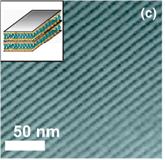
MCM-41 (Mobil Crystalline Materials) is an amorphous silica comprising of an array of unidirectional, 2-D hexagonal mesopore structure with an extremely high surface area of ˃ 1000 m2/g-1. This mesoporous molecular sieve (M41S) was discovered by scientists of Mobil Oil Research and Development 1992. Since that, it has attracted extensive attention of researchers in academia and industry because of its large pore, large surface area, thernal stability and mild acidy property, and it has been implemented in order to increase the acidity, ion exchange capacity and specific catalytic activity of mesoporous silica molecular sieves (Hui K. S., 2006).

There are three different mesophases in MCM that have been identified, Lamellar (MCM-50), cubic (MCM-48), and hexagonal (MCM-41) phases. MCM-41 possesses highly regular arrays of uniform-sized channels whose diameters are in the range of 15-100 Å depending on the templates used, the addition of auxiliary organic compounds, and the reaction parameters (Xiu S. Zhao, 1996).

Cubic

Hexagonal
Lamellar

MCM-41 can be synthesized by mixing organic amine (surfactants), silica, and/or silica-alumina source to form a supersaturated solution while maintaining the mixture at a temperature between 70 and 150 °C for selected periods of time. The figure (below) shows the mechanism of liquid crystal templating via two possible pathways (Beck et al., 1992a).


The randomly ordered rodlike micelles interact with silicate species by Cou-lombic interactions in the optimal reaction mixture to produce approximately two or three monolayers of silicate encapsulation around the external surfaces of the micelles. These randomly ordered composite species spontaneously pack into a highly ordered mesoporous phase with an energetically favorable hexagonal arrangement, accompanied by silicate condensation. With the increase in heating time, he inorganic wall continues to condense (Xiu S. Zhao, 1996).

Reference : K.S. Hui, C.Y.H. Chao 2006 J. Haz. Mater. B137 1135-1148
                 Xiu S. Zhao, G.Q. (Max) Lu, and Graeme J. Millar Ind. Eng. Chem. Res. 1996, 35, 2075-2090
             George L. Athens, Ramzy M. Shayib, Bradley F. Chmelka J. Cur. Opi. Int. Sc. 14 (2009) 281-292
             Beck, J.S; Vertuli, C.; Roth, W. J.; Leonowicz, M. E.; Kresge, C. T.; Schmitt, K. D.; Chu, C.T-W.;  
                              Olson, D. H.; Sheppard, E. W.; McCullen, S. B.; Higgins, J. B.; Schlenker, J. L. A New 
                               Family of Mesoporous Molecular Sieves Prepared with Liquid Crystal Templates. J. 
                              Am. Chem. Soc. 1992a, 114, 10834-10843.


Zeolite

Zeolites are crystalline aluminosilicates with a 3-dimentional, open anion framework consisting of oxygen-sharing TO4 tetrahedral, where T is Si or Al. Their framework structure contains interconnected voids that are filled with adsorbed molecules or cations. Zeolite micropore channels have very well-defined diameters so that bulky molecules will be excluded from the internal surface. The general empirical formula is :
                       
                               Mx/m  .  AlxSi2-xO4  .  nH2O

Where m is the valence of cations M, n the water content and 0 ≤ x ≤ 1 (Houssin, 2003).

Zeolites are composed of pores and corner-sharing aluminosilicate (AlO4 and SiO4)tetrahedrons, joined into 3-dimensional frameworks. The pore structure is characterized by cages approximately 12 Å in diameter, which are interlinked through channels about 8 Å in diameter, composed of rings of 12 linked tetrahedrons (Kaduk and Faber, 1995). The pores are interconnected and form long wide channels of varying sizes depending on the mineral. These channels allow the easy movement of the resident ions and molecules into and out of the structure. Zeolite have large vacant spaces or cages within and resemble honeycomb or cage like structures. The presence of aluminium results in a negative charge, which is balanced by positively charged cations (E. Polat et al., 2004).

There are two types of zeolite :
1.       Natural Zeolites
These zeolites are found in volcanic or metamorphic rocks and their growth involves geological conditions (low temperature and pressure, low pH (8-9)) and time scale (thousands of years). There are more than fourty types of these  zeolites that have been reported by different research group. Among these minerals, analcime (sometimes known as analcite), clinoptilolite, erionit, chabazite, mordenite, and philipsite are well known (Doğan, 2003).

2.       Synthesize Zeolite
                   There are more than 150 zeolites that have been syntesized. Some of the common synthetics are              
                   zeolites A, X, Y and ZSM-5. (the descriptions of these zeolites will come soon) ^v^”


There are four types of applications that zeolites are used for:
1.       Drying agents (used for drying solvents)
2.       Shape selective separations (e.g. dewaxing desel fuel)
3.       Shape selective catalysis (predominantly acid catalysis, but also redox)
4.       Selective ion exchangers (water softeners, radioactive waste treatment) (Wilkinson A. P.)

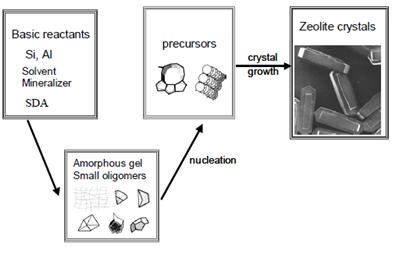
A schematic reperesentation of zeolite formation process is given in this figure.
Simplified zeolite synthesis scheme. SDA stands for structure-directing agent (Houssin, 2003).

References : Houssin, Christophe J.Y. 2003 Nanoparticles in zeolite synthesis Eindhoven : Technische 
                                            Universiteit Eindoven
          E. Polat, Mahmet K., Halil D. and A. Naci Onus, 2004 J. Fruit Ornam. Plant Res.vol. 12
                          Kaduk J. A. , Faber J 1995. Crystal structure of zeolite Y as a function of ion exchange. RIGAKU J.
                                             12: 2, 1434
                          Doğan H. 2003. Doğal ve Sentetik Zeolitler ve Uygulama Alanları, Bor Teknolojileri ve Mineraller 
                                             Grubu. TÜBİTAK Marmara Araştırma Merkezi .
         Wilkinson, Angus P., School of Chemistry and Biochemistry Georgia Institute of Technology 
                              Atlanta, GA 30332-0400